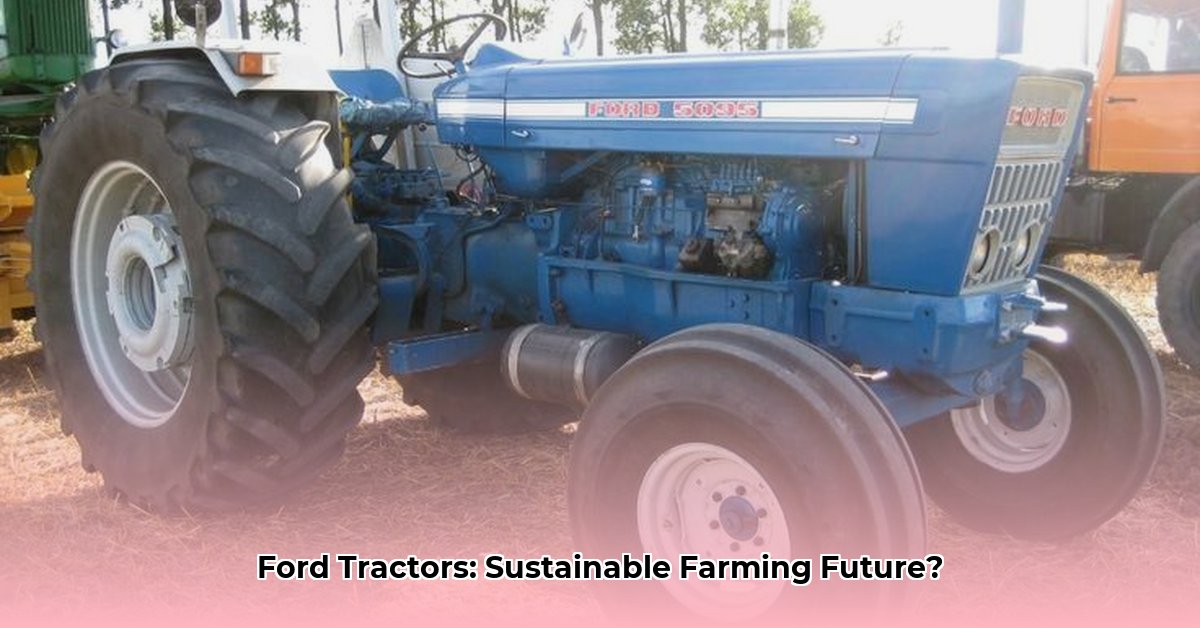
Ford's blue tractors are iconic symbols of American agricultural innovation. Their impact on farming practices is undeniable, but how does their legacy square with modern concerns about sustainability? This article delves into the history of Ford tractor models, examining their evolution, impact on farming, and the environmental implications of their use. We will explore the trade-offs between productivity and sustainability, considering both the advantages and disadvantages of various models, from the classic 8N to the latest designs. For a visual guide to different models, see this Ford tractor models.
The Dawn of Mechanization and its Environmental Footprint
Before Ford tractors, farming was intensely labor-intensive. The introduction of the Fordson, followed by the iconic 9N and 8N models, revolutionized agriculture. These rugged, relatively affordable machines enabled farmers to cultivate more land and increase yields dramatically, improving their livelihoods. But this revolution came at a cost. Early Ford tractors, while efficient for their time, lacked modern fuel-efficiency and emission controls. Did this early mechanization, while boosting food production, lay the groundwork for future environmental challenges? This is a crucial question that shapes our understanding of the Ford tractor legacy.
A Century of Evolution: Performance and Sustainability Trade-offs
Following the 8N's success, Ford continuously improved its tractor designs. Each generation brought increased power, more sophisticated engines, and user-friendly features like the three-point hitch. These advancements consistently enhanced productivity, but also extended the environmental impact. The 1964 merger of Fordson and Ford tractor lines expanded Ford's global reach, influencing farming practices worldwide. How did this global expansion affect the overall environmental impact of Ford tractors? This question necessitates examining fuel consumption patterns and emissions across different regions and farming practices.
Sustainability Takes Center Stage: Adapting to a Changing World
Growing awareness of climate change and resource depletion forced a reassessment of agricultural practices. The sale of Ford's tractor division to Fiat (now New Holland) marked a significant shift. The industry began prioritizing fuel efficiency and emission reduction. What technological advancements were introduced to improve the sustainability of agricultural machinery, and how successful were they? This necessitates exploring innovations in engine technology, alternative fuel sources, and precision farming techniques.
Assessing the Environmental Impact: A Multifaceted Approach
The legacy of Ford tractors is complex. They undeniably increased food production, but their environmental impact demands thorough analysis. A significant hurdle is the lack of comprehensive data on fuel consumption and emissions for all Ford tractor models throughout their lifecycles. This data gap hinders a complete assessment. "We desperately need more robust data on the complete lifecycle emissions of these machines," says Dr. Eleanor Vance, Agricultural Engineer at the University of California, Davis. This lack of information necessitates further research and transparency from both manufacturers and independent researchers.
Older Ford Tractors and Sustainable Farming: A Case Study
While newer tractors dominate modern farms, older Ford tractors offer a unique angle on sustainability. Their robust construction leads to longer lifespans, reducing the waste associated with frequent replacements. "The longevity of these machines is a significant factor," states Mr. Thomas Miller, a farmer from Iowa with over 40 years of experience. "They were built to last, which minimizes the environmental cost of frequent replacements unlike some modern machines." However, their limitations, including lower power, simpler technology, and potential parts scarcity, must be weighed against these benefits.
The Path Forward: Collaboration for a Greener Future
Creating a sustainable agricultural sector requires collaboration. Farmers, manufacturers, researchers, and policymakers must work together. This includes investment in research and development, policies promoting sustainable farming, and a commitment to transparently evaluating the environmental impact of agricultural machinery. The Ford tractor story, with its highs and lows, serves as a valuable lesson. The future of sustainable agriculture demands continuous improvement and innovation.
Key Takeaways: A Sustainable Legacy?
- Longevity: Older Ford tractors, built for durability, demonstrate a potential advantage in reducing waste from frequent machinery replacements.
- Relative Fuel Efficiency: In certain applications, older models may show better fuel efficiency per task compared to newer, more powerful machines, although absolute fuel consumption remains a relevant factor.
- Data Gaps: A comprehensive analysis of the complete environmental impact of Ford tractors across their lifecycles is hampered by the lack of extensive data on fuel consumption and emissions across all models. Further scholarly investigation is crucial.
The Ford tractor's legacy is a complex interplay of innovation and environmental impact. While its contribution to agricultural productivity is indisputable, achieving a truly sustainable future in farming demands continuous improvement and a holistic approach to resource management. The journey towards a greener agriculture isn't just about technology; it's about responsible practices and a commitment to a sustainable future.